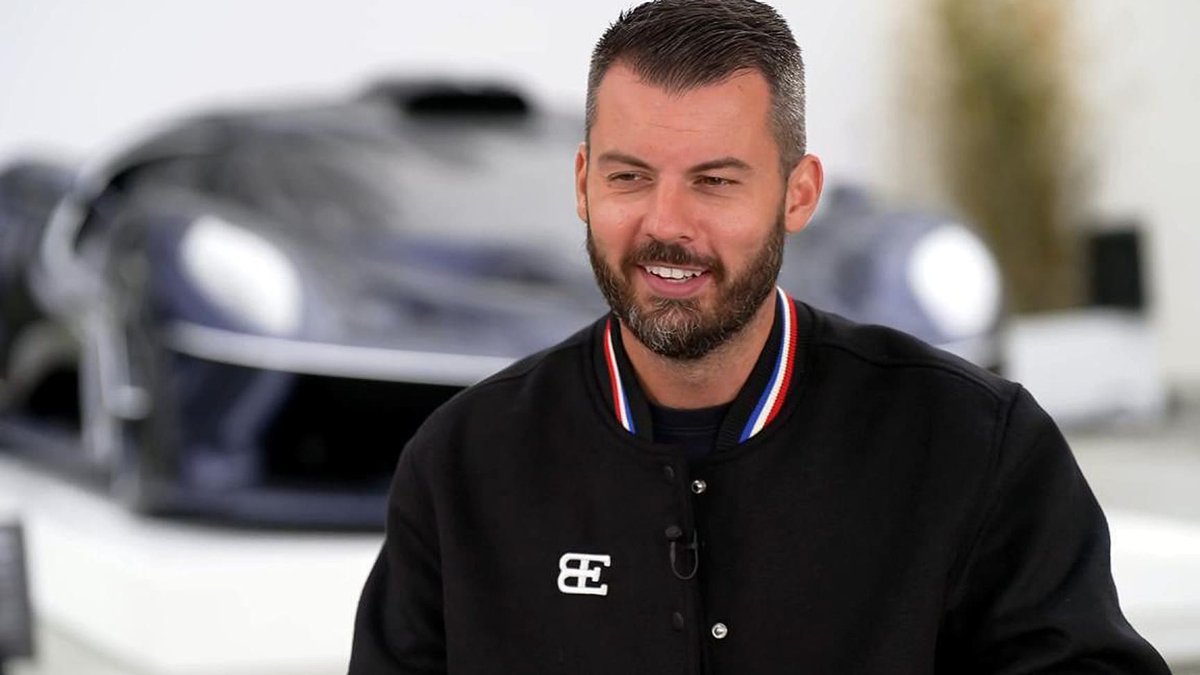
Bugatti CEO Mate Rimac predicts the supercar market is entering a “Swiss watch phase,” where wealthy buyers reject high-tech electronics and electric vehicles in favor of precision mechanics and hand-crafted details. The 38-year-old entrepreneur, who took over the iconic brand in 2021, argues the automotive industry is splitting in two: the mainstream global market is becoming dominated by lower-priced EVs from China, while the top segment will remain driven by combustion engines.
Expensive mechanics over smart technology. Rimac compared the current car market to the watch industry, where digital and smart devices have taken over the majority of the market, yet high-priced Swiss mechanical options still generate the bulk of profits. He noted that while an Apple Watch can do more things, no one will pay $200,000 for it.
“For normal cars, normal people, the vast majority will be electric,” Rimac said. “The upper segment, like sports cars and upwards, are going to stay combustion for a very long time, exactly like watches.”
Related: Warsh Speech Boosts Hike Odds, Strains Fed-Treasury Ties
It is a strategy that has already produced results. When the EV startup gained control of Bugatti from Porsche and Volkswagen in 2021, many expected the newly formed group to launch an electric iteration of the car. Instead, the company built the Tourbillon, a hybrid powered by one of the largest naturally aspirated combustion engines ever built for production. The car features an 8.3-liter V16 that delivers 1,000 horsepower, combined with electric motors for a total of 1,800 horsepower.
“It’s kind of ironic that I’m now making the world’s biggest combustion engine,” he said. “You have the crazy situation now at our facility in Croatia. On the same production line, you have the world’s most powerful electric car being built right next to the world’s biggest combustion engine. Life is strange sometimes.”
Customization defines the supercar segment
Bugatti is banking on this differentiation. The company will produce only 250 Tourbillons, which are sold out at a starting price of roughly $4.5 million. Rimac said the average Tourbillon customer adds another $600,000 to $700,000 in personalization add-ons, including special paint colors, leathers, and stitching. The rise of personalization and one-off cars has become a major profit driver for supercar companies.
Related: Self Assessment Tax Payments Now Processed via PAYE
At Monterey Car Week, Bugatti unveiled its latest one-off, the Destrier, which reimagines its track-based Bolide model with a lower stance, larger wheels, and sculptural body work. Rimac said these customizations reflect a desire among wealthy clients to have unique objects that reflect their identity. “For these clients, they want something that’s really theirs, that’s connected with them,” he said. “It tells their story, their personality, their preferences, not just like a car. It’s a story behind it.”
Rimac said his goal for Bugatti is to boost production, quality, and profits while retaining exclusivity. He set a ceiling on production at “the low three-digit numbers.” The company earned 200 million euros (US$233 million) in earnings before interest, taxes, depreciation, and amortization last year. Porsche AG agreed in April to sell its 45% stake in Bugatti Rimac to a global consortium led by HOF Capital. While some reports cited a valuation of over $1.1 billion for Bugatti, the CEO said the valuation is “substantially higher” than $2 billion.
In an era of artificial intelligence and autonomous vehicles, Rimac believes the guiding principal for Bugatti is the human factor. He argues that performance is becoming secondary to the celebration of human skills. “You can get a car that’s faster than any performance car from 10 years ago for like $50,000 from China,” he said. “When you look at these cars, you see the amount of ingenuity and art and beauty. The car is, like, the most complex object you can buy. It’s art, but it’s art that needs to go 250 miles per hour and be safe, have downforce and survive in a crash test and go in the snow and extreme heat, and all those things.”


