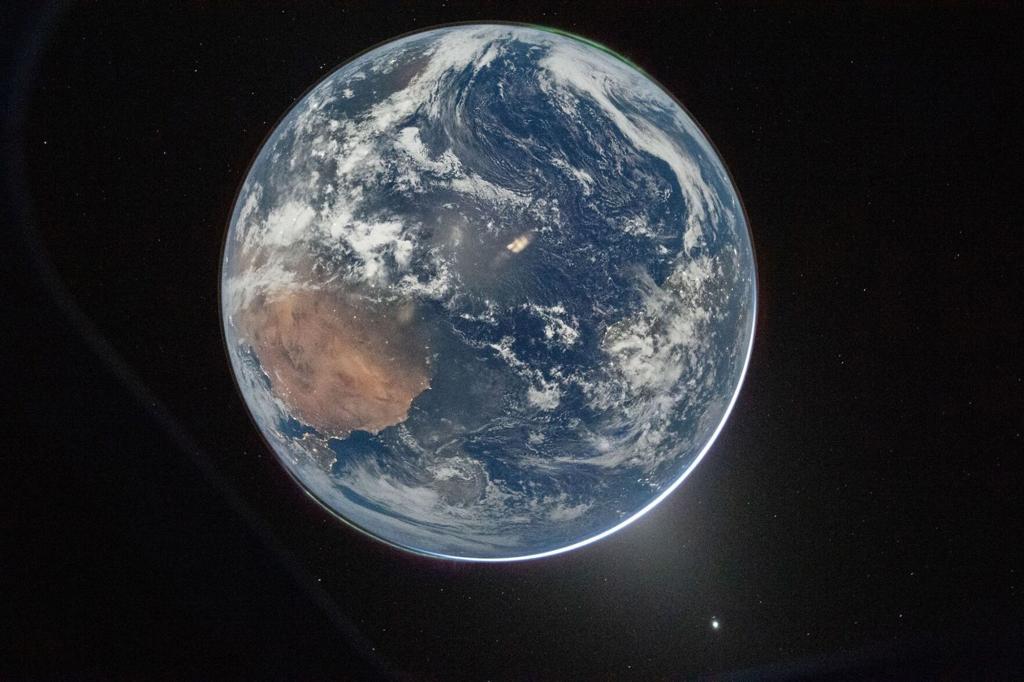
NASA Releases Stunning First Images of Earth Taken by the Artemis II Astronauts

In a moment that blends scientific achievement with profound human wonder, “NASA releases stunning first images of Earth taken by the Artemis II astronauts”—a milestone that captures not just a technological triumph, but a deeply emotional perspective of our place in the cosmos.

These images, transmitted from the Orion spacecraft as it journeys toward the moon, offer a rare vantage point. Not low Earth orbit. Not a distant satellite feed. But a human взгляд—raw, immediate, and deeply personal.

A View Unlike Any Other

The photographs were taken by mission commander Reid Wiseman using a handheld device—simple in concept, extraordinary in consequence. A tablet. A camera. A window to infinity.

The result is breathtaking.

Earth appears suspended in the void, luminous and fragile. In one frame, the planet is bathed in the fading glow of sunset. Auroras shimmer delicately at the edges, their ethereal ribbons dancing across polar regions. Beneath them, a faint band of zodiacal light stretches outward—a subtle cosmic glow often invisible from the surface.

Short sentence: it is mesmerizing.

Another image, captured moments later with a shorter exposure, reveals a different personality of Earth. Nightfall dominates. Cities emerge as constellations of artificial light, scattered across continents like …

What to Know About the 4 People Launching to Make History Around the Moon

Humanity stands on the precipice of a new lunar chapter. Not a return rooted in nostalgia, but a forward-looking अभियान shaped by diversity, innovation, and calculated risk. The mission at the center of this moment is Artemis II, and the story it carries is captured succinctly in the phrase: “What to know about the 4 people launching to make history around the moon.”

This is not merely a spaceflight. It is a redefinition of who gets to explore the cosmos.

A Crew That Reflects a Changing Era

For the first time in history, a lunar-bound crew will include the first woman, the first person of color, and the first Canadian to venture into deep space. This marks a profound departure from the Apollo era, when astronauts were drawn from a narrow demographic—predominantly White American men with military pedigrees.

Yet, while representation has evolved, excellence remains constant.

Each member of the Artemis II crew embodies the rigorous standards required for such an audacious mission. Their résumés are not symbolic—they are formidable.

Short truth: this is history in motion.

Meet the Four Explorers

The Artemis II crew consists of four individuals, each bringing a distinct combination of experience, temperament, and purpose.

Reid

How Filming Your Chores Could Train the Android Butlers of the Future

The concept sounds almost mundane. Strap a camera to your head. Pick up your phone. Wash dishes, fold laundry, tidy a ოთახ. Yet beneath this seemingly trivial routine lies a transformative فكرة—one that could redefine how machines learn to serve humanity. The phrase “How filming your chores could train the android butlers of the future” is not speculative fantasy; it is an emerging paradigm in artificial intelligence and robotics.

The Rise of Human-Centered Training Data

For decades, robots have been trained in controlled environments. Factories. Laboratories. Simulations. Precision ruled. Variables were minimized. Outcomes were predictable.

Homes are different.

They are chaotic, dynamic, and deeply personal. Chairs move. Objects disappear. People interrupt. No two kitchens are identical. No two households operate the same way.

This complexity presents a formidable challenge for developers seeking to create general-purpose humanoid robots. Machines must not only perform tasks—they must understand context. And that understanding requires data. Vast quantities of it.

Enter human-generated footage.

Short clips. Long recordings. Thousands of hours of ordinary actions—cooking, cleaning, organizing—captured from a first-person perspective. This “egocentric data” offers something simulations cannot fully replicate: authentic human interaction with the physical world.

A New Kind of Workforce

An unexpected labor market has …

What a Surprisingly Strong March Jobs Report Means in the Face of War

In an era defined by geopolitical तनाव and economic ambiguity, labor market resilience can feel almost paradoxical. Yet the latest employment data has delivered precisely that—a robust and unexpectedly strong performance. The phrase “What a surprisingly strong March jobs report means in the face of war” encapsulates a moment where economic fundamentals appear to defy external instability.

At first glance, war and workforce expansion seem incompatible. Conflict typically breeds uncertainty, disrupts trade flows, and undermines business confidence. However, the March jobs report tells a different story—one of underlying economic durability and adaptive momentum.

A Labor Market That Refuses to Falter

The March employment figures exceeded expectations across multiple dimensions. Job creation surged beyond consensus forecasts, unemployment remained historically low, and wage growth demonstrated continued, albeit measured, acceleration. These indicators collectively suggest a labor market operating with remarkable tenacity.

Short sentences tell part of the story. Hiring is strong. Layoffs are limited. Demand persists.

Longer observations reveal deeper structural قوت. Employers, having faced persistent labor shortages in recent years, appear reluctant to reduce headcount even amid geopolitical uncertainty. This phenomenon, often described as “labor hoarding,” reflects a strategic recalibration—companies are prioritizing workforce retention over short-term cost-cutting.

Such behavior reinforces the central …

It’s Tax Day. Still Haven’t Filed? Tips on How to Get an Extension and More

Tax season culminates in a single, immovable deadline. For millions of Americans, April 15 arrives with a मिश्रण of urgency, confusion, and last-minute scrambling. The phrase “It’s Tax Day. Still haven’t filed? Tips on how to get an extension and more” resonates not as a gentle reminder, but as a pressing call to action.

The Internal Revenue Service (IRS) has already processed over 100 million returns this year, yet tens of millions more are expected to arrive—some within hours, others in the months ahead due to extensions. If the deadline feels imminent and unmanageable, there are still strategic steps available to regain control.

Start With the Essentials

Preparation begins with documentation. Without the proper records, even the most sophisticated filing approach will falter.

Gather everything. Then double-check.

W-2 forms from employers are fundamental for salaried workers. Freelancers and independent contractors should locate 1099-NEC or 1099-MISC forms, reflecting non-employee compensation. Increasingly relevant is the 1099-K, particularly for those using digital payment platforms for business transactions exceeding $5,000.

Additional forms matter. Interest income, dividends, and capital gains are typically reported through brokerage-issued 1099s. Retirement distributions arrive via Form 1099-R. Each document contributes to the fiscal mosaic that defines taxable income.

Miss one, …

Trump Can’t Make His Mind Up About the Strait of Hormuz. It’s More Important Than He Lets On

Geopolitics rarely tolerates inconsistency, yet recent rhetoric from Washington has embodied precisely that. The evolving stance surrounding one of the world’s most critical maritime chokepoints reveals a deeper tension—between perception and reality, independence and interdependence. At the center of this contradiction lies the assertion: “Trump can’t make his mind up about the Strait of Hormuz. It’s more important than he lets on.”

It begins with dismissal. A confident declaration that the United States no longer needs oil flowing through the Strait of Hormuz. A posture of self-sufficiency. Energy independence, framed as insulation from global turmoil.

Then comes the reversal. Urgency replaces indifference. Threats escalate. Language sharpens. The پاڻيway once portrayed as irrelevant suddenly becomes indispensable.

What changed? The answer is neither subtle nor surprising: price.

The Shock of the Oil Market

Oil prices do not merely fluctuate—they reverberate. A surge of more than 11% in a single day is not an ordinary market movement; it is a տնտեսական tremor. When crude breaches the $110 threshold, it sends ripples across industries, households, and policy frameworks.

Before the escalation, prices hovered near $70. Then $100. Then higher still.

Such volatility underscores a fundamental truth embedded in “Trump can’t make his mind up

Savannah Guthrie Set for ‘Today’ Show Return, as the Search for Her Mom Continues

In the ever-evolving cadence of morning television, where routine often offers comfort and familiarity, a deeply human story has emerged—one that transcends ratings, headlines, and the polished veneer of broadcast journalism. At its center stands a figure known for composure under pressure, now navigating a profoundly personal crisis. The narrative surrounding “Savannah Guthrie set for ‘Today’ show return, as the search for her mom continues” reflects not only a professional milestone but an emotional reckoning.

A Return Marked by Resilience

After weeks of absence, Savannah Guthrie is preparing to return to NBC’s flagship morning program, “Today.” Her reappearance is not merely a scheduling update; it is a testament to resilience forged in uncertainty. For two months, Guthrie has lived in a state of agonizing liminality, her mother, Nancy, missing under deeply troubling circumstances.

Her return to the anchor desk on Monday signals a deliberate choice—to reengage with the world despite the ભાર of unresolved grief. It is a quiet act of defiance. A statement that life, however fractured, must continue.

Short sentences carry weight. This one does too: she is coming back.

The Disappearance That Changed Everything

Nancy Guthrie vanished under mysterious conditions from her home in Arizona’s Catalina Foothills. …

Stocks, Bonds and Gold All Fall in Market Slide: A Rare Convergence of Losses

New York — Global financial markets are experiencing an unusual and unsettling phenomenon: simultaneous declines across traditionally diversified asset classes. The phrase “Stocks, bonds and gold all fall in market slide” is no longer مجرد headline rhetoric—it reflects a tangible erosion of conventional hedging strategies that investors have long relied upon.

Typically, when equities falter, capital migrates toward perceived safe havens such as government bonds or precious metals. Yet this time, that defensive rotation appears conspicuously absent. Instead, markets are moving in uneasy unison, amplifying investor anxiety and constricting avenues for risk mitigation.

A Market Under Pressure

Recent trading sessions have underscored the severity of the downturn. Major US indices—the Dow Jones Industrial Average, S&P 500, and Nasdaq Composite—are all tracking toward their worst monthly performances in over a year. On Thursday alone, the Dow dropped 469 points (1.01%), while the S&P 500 declined 1.74%, marking its sharpest single-day loss in two months. The Nasdaq, heavily weighted toward growth stocks, plunged 2.38%, officially entering correction territory after falling more than 10% from its late-October peak.

This synchronized decline exemplifies the core concern behind “Stocks, bonds and gold all fall in market slide”—a breakdown in diversification benefits during periods of …